
Steelhead anglers spend a lot of time talking about rods, reels, line, leaders, hooks, floats and bait. We’ll spend hundreds of dollars getting our setups exactly the way we want them. Then everything comes down to something that costs absolutely nothing: The knot. You can have the best equipment money can buy, but when a big steelhead turns downstream and starts peeling line, every connection in your setup is going to be tested. Over the years, I’ve learned that I don’t need dozens of different knots. I want a few that I know, trust and can tie correctly every single time. For steelhead fishing, three of my favorites are the Palomar knot, Egg Loop knot and Snell knot.
The Palomar Knot
The Palomar is one of my favorite knots because it’s simple, strong and dependable. I use it anywhere the application makes sense and I want a connection I don’t have to second guess. It doesn’t require a complicated series of wraps, and once you learn to tie it correctly, you can
tie one quickly – even when your hands are cold. One important detail: make sure the knot seats cleanly. Wet the line before tightening it and pull it
down smoothly. A knot that overlaps itself or cinches incorrectly can weaken your connection. Simple doesn’t mean careless.
The Egg Loop Knot
If you’ve spent much time fishing eggs or yarn for steelhead and salmon, you probably already
understand the value of an Egg Loop. The beauty of this knot is that the loop allows you to secure your bait while keeping the hook
available to do its job. Whether I’m fishing spawn, yarn or another bait that benefits from being held in a loop, this is one of
those knots that has earned a permanent place in my steelhead fishing. Like any knot, consistency matters. Learn the wraps, practice it and tie it the same way every time.
The Snell Knot
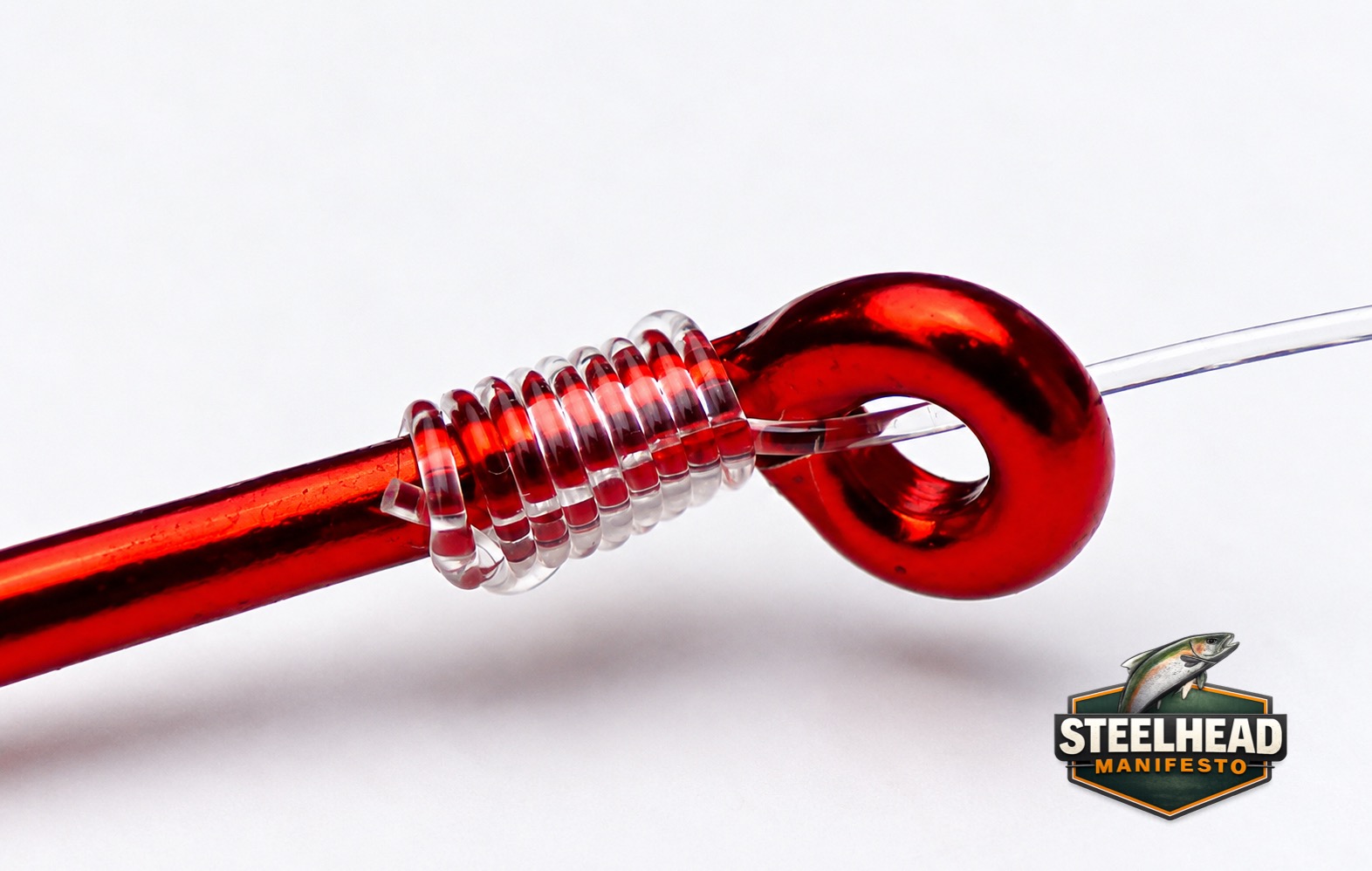
The Snell is another connection I have a lot of confidence in. Rather than simply tying your leader to the eye of the hook, a properly tied Snell wraps around the shank of the hook. It’s a strong, clean connection and one I’ve trusted for years. There are different ways anglers tie a Snell, and everyone seems to have their preferred number of wraps and technique. What’s more important than arguing over the exact method is being able to reproduce a strong, clean knot every time.
Your Knot Deserves More Attention
Here’s something I think anglers overlook. Don’t wait until you’re standing in the river to learn a knot.
Practice at home. Tie them while you’re watching TV. Tie them with heavier line until your hands learn the movements.
Then move down to the leader sizes you actually fish. You want tying these knots to become muscle memory.
Because eventually you’re going to be standing in 35-degree water with cold fingers, low light and fish moving through. That’s not the time to pull out your phone and start looking up how to tie a knot. And whenever you tie one, inspect it. Wet it. Cinch it slowly. Look at it. Pull on it.
If something doesn’t look right, cut it off and tie it again.
Leader material is cheap.
Losing the biggest steelhead of your season because you didn’t want to spend another 30 seconds tying a knot isn’t.
Confidence Starts at the Knot
There are plenty of good fishing knots out there. I’m not going to tell you that the Palomar, Egg Loop
and Snell are the only three you should use. They’re simply three that I’ve developed confidence in after years of steelhead fishing.
That’s really what matters.
Pick proven knots. Learn to tie them correctly. Practice them until you don’t have to think about it.
And never be afraid to cut off a knot that doesn’t look perfect.
You’ll forget a thousand good knots. You’ll remember the one bad knot that cost you the steelhead of a lifetime.
Roger Hinchcliff